
European Hotel Transactions Report 2025
Updated: Mar 14


Selected Markets:
Austria
Belgium
Czech Republic
Denmark
Finland
France
Germany
Greece
Hungary
Ireland
Italy
Netherlands
Norway
Poland
Portugal
Romania
Serbia
Slovenia
Spain
Sweden
Switzerland
United Kingdom (UK)
Only transactions exceeding €17.5 million have been included in this study.
All prices have been converted to Euros using exchange rates at the time of each transaction.
Ultra-luxury assets have been classified within the Luxury segment, and upper-upscale assets within the Upscale segment.
Executive Summary
The European Central Bank's decisions to ease monetary policy contributed significantly to improved investor confidence, fostering an environment of increased liquidity. Furthermore, recent data shows a notable decline in inflation rates in the latter half of the year, encouraging greater investment in the hospitality sector.
Resilient travel demand has underscored the sector's recovery, driving renewed interest from investors. However, the ongoing geopolitical uncertainties have prompted a shift towards disciplined underwriting practices. Investors are now adopting selective capital deployment strategies, ensuring that investments are aligned with thorough risk assessments. As a result, many transactions are experiencing extended timelines, reflecting a cautious yet strategic approach to navigating the complexities of the current market landscape.
Across the continent, 267 hotel transactions were completed, representing €14.65 billion in investment volume and 45,052 keys traded. The Upscale segment attracted the largest share of capital, followed by Luxury, while Midscale and Economy accounted for the remainder. This distribution reflects a continued investor preference for scalable, resilient assets in an environment shaped by external volatility.
This report provides a detailed analysis of transactions completed during 2025, incorporates selected deals from January 2026 and reviews the key trends shaping the market.

Macroeconomic & Performance Backdrop
Europe’s hotel investment market in 2025 was shaped by easing monetary policy, resilient travel demand, and stabilising inflation, all set against a backdrop of continued geopolitical and policy uncertainty that kept underwriting disciplined and investors selective.
Inflation moved closer to normal levels during the year, helping support real incomes and sustain discretionary travel demand. However, services inflation and wage-related cost pressures remained areas of focus for central bankers and operators alike.
Monetary policy played a central role in shaping market sentiment. The European Central Bank reduced its deposit facility rate from 3.00% in December 2024 to 2.00% by June 2025 and maintained that level through the end of the year. This shift supported improved debt availability and helped restore a degree of confidence among investors.
At the same time, travel demand continued to provide a strong foundation for the sector. European flight activity in 2025 exceeded 2019 levels, with passenger volumes reaching record highs. Business travel also continued its gradual global recovery, contributing to stronger weekday demand in key gateway cities.
The broader European economic narrative remained steady throughout the year. Moderate growth, cooling headline inflation, and supportive employment conditions created a relatively stable macroeconomic backdrop. Eurostat estimated euro area GDP growth at 1.5% in 2025, while the wider EU recorded growth of 1.6%. Unemployment stood at 6.2% in December 2025, reflecting a relatively tight labour market. Private consumption expanded by 1.2% in real terms, supporting domestic and intra-European travel demand.
Political and geopolitical developments nevertheless continued to influence investor behaviour. Uncertainty around trade policy shifts and broader geopolitical tensions raised hurdle rates for marginal transactions and reinforced a preference for high-quality assets and prime locations. At times, this uncertainty also slowed capital deployment across the wider European commercial real estate market.

Demand fundamentals across the tourism sector remained strong. The European Union recorded a historic 3.08 billion nights in tourist accommodation establishments during 2025. Eurocontrol reported 10.2 million flights, approximately 5% above 2019 levels, an important signal given the role airline capacity plays in supporting higher value inbound tourism.
Hotel performance metrics reflected a market transitioning from the initial rate-driven recovery to more balanced growth. Revenue per available room growth was increasingly supported by occupancy rather than rate alone, a dynamic generally viewed as more sustainable from an underwriting perspective, particularly when lenders stress test future cash flows. The continued recovery of business travel also supported weekday occupancy and stronger corporate demand in major European cities.
One element of the long-haul recovery remained incomplete. Travel from Mainland China to Europe had resumed and was steadily improving, but visitor volumes in 2025 remained below 2019 levels and were not expected to fully normalise until 2026. This remains significant because Chinese overnight stays historically play a disproportionate role in supporting luxury retail corridors and urban luxury hotels in markets such as Paris, Milan, and London.
2025 in Numbers

In 2025, the EMEA hotel investment market recorded 267 transactions, representing €14.65 billion in total volume. These deals comprised 45,052 keys, with an average transaction size of €54.9 million and assets trading at €325k per key.

Volume and Number of Transactions
Luxury recorded 34 transactions totalling €3.66 billion, with an average transaction size of €107.6 million.
Upscale led the market with 132 transactions totalling €7.66 billion, with an average deal of €58.0 million.
Midscale & Economy accounted for 101 transactions totalling €3.33 billion, with an average deal size of €33.0 million.

Average Transaction, Total Keys and Average Price per Key
Luxury transactions comprised 5,535 keys, trading at €661,111 per key.
Upscale assets represented 24,949 keys, at €306,909 per key.
Midscale & Economy totalled 14,568 keys, at €228,715 per key.

Notably, the Upscale segment demonstrated structural dominance: nearly 50% of all transactions (49.4%) and over 52% of total invested volume. More than half of all capital deployed in 2025 was directed towards Upscale assets alone.
What's Happening in the Upscale and Upper-Upscale Market?
In 2025 EMEA data, Upscale is the structural centre of the hotel investment market. European development trends point in the same direction.
The pipeline confirms this positioning. Upscale leads by number of projects (367 projects / 57,028 rooms at Q4 2025), while Upper-Upscale has reached record levels (307 projects / 48,969 rooms). Together, the two segments represent approximately 39% of total projects and 42% of rooms in Europe's active pipeline (total: 1,717 projects / 252,600 rooms). Brand expansion, conversions, and repositionings are increasingly concentrated in these tiers rather than in the most cost-pressured segments. Renovations and conversions combined reached 700 projects / 90,066 rooms, up year-over-year.
Construction activity remains elevated, with 754 projects / 115,289 rooms under construction at Q4 2025. New openings totalled 255 hotels / 30,603 rooms in 2025. Forecasts show continued growth: 315 hotels / 44,666 rooms expected in 2026, and 320 hotels / 44,625 rooms in 2027—though some delivery slippage persists due to financing challenges, cost pressures, and extended timelines (typically affecting 10–15% of projects).
The United Kingdom (UK) leads pipeline activity (274 projects / 39,515 rooms), followed by Germany (147 projects / 25,616 rooms). London (76 projects / 13,657 rooms) is the most active city.
What this Means for Investors and Operators?
Current strength in Upscale and Upper-Upscale is not purely a supply story; it aligns with demand and pricing dynamics. Leisure travel remains the principal demand driver across Europe, with resilient inbound and domestic flows. Corporate and group travel continue to recover, with international meetings and events surpassing pre-pandemic levels in many markets. This backdrop favours well-located, branded assets with balanced demand mix (leisure + corporate).
Performance is becoming increasingly differentiated by tier. Upper-tier hotels retain stronger pricing power, supported by sustained ADR gains in key gateways. In contrast, parts of the midscale urban market face margin pressure from elevated operating costs, labour shortages, and price-sensitive guests. Upper-Upscale stands out: it delivers higher ADR potential than midscale while offering broader scalability and deeper liquidity than pure luxury—making it attractive for institutional and value-add strategies.

Although the luxury hotel segment continues to attract interest due to its high profitability, it faces challenges such as elevated operational costs and a more niche market focus, increasing the overall risks. Meanwhile, the Upscale and Upper-Upscale segments are garnering the majority of investment in Europe, appealing to a broader audience and balancing leisure and corporate demand. This enhances overall occupancy and revenue potential, positioning these segments favorably for investors seeking scalability and liquidity.
Caution is advised:
In dense pipeline markets such as the UK and parts of Germany, multiple branded openings can compress ramp-up periods, intensify rate competition, and increase capex expectations, particularly as renovation cycles resume after several years of underinvestment.
Broader risks include modest RevPAR growth (forecast 1–3% in 2026, often ADR-driven in upper tiers), supply constraints in most cities (<2% of stock), but localised oversupply pressure in hotspots like London.
Opportunities exist: ESG-certified assets command premiums (up to 5%), and events (upcoming major tournaments) will boost group demand.
Overall, these segments offer the best risk-return balance: financeable, operationally predictable, and liquid at exit.
Quarterly Trends
Quarterly activity remained balanced, with capital deployment consistently above €3.4 billion per quarter.

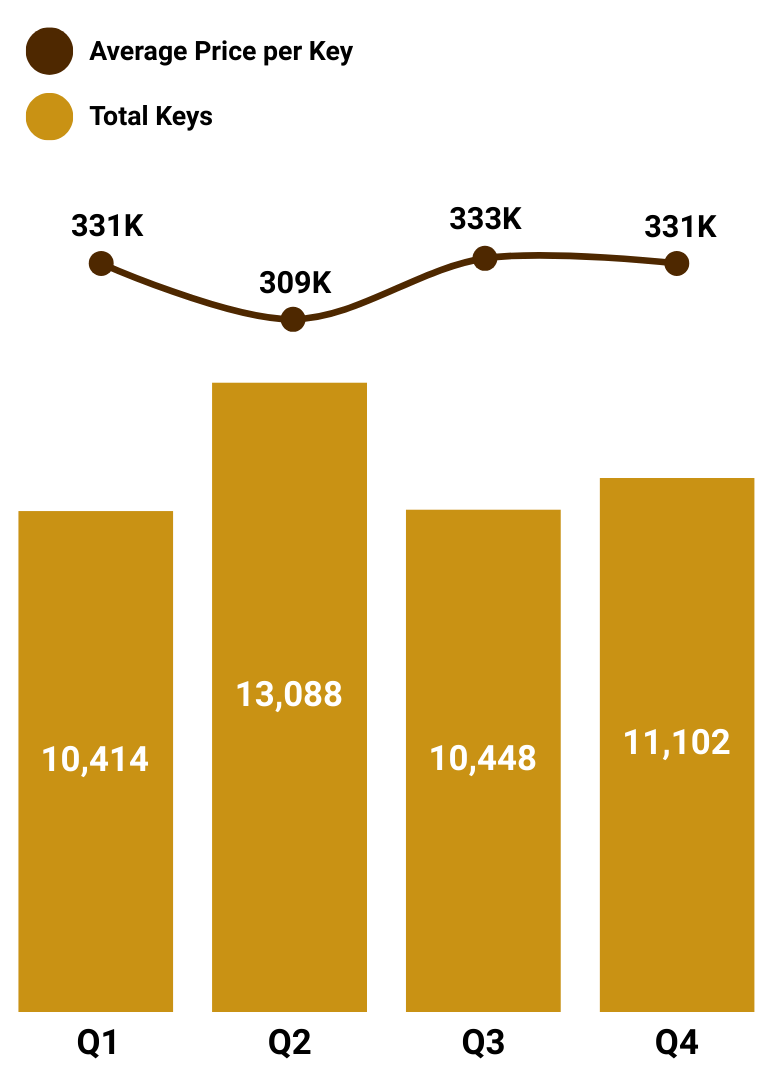

Q1: 67 transactions | €3.45bn volume | €51.5m average deal size
Q2: 71 transactions | €4.04bn volume | €57.0m average deal size
Q3: 62 transactions | €3.48bn volume | €56.1m average deal size
Q4: 67 transactions | €3.68bn volume | €54.9m average deal size
Quarterly Trends per Segment
Number of Transactions
Upscale led every quarter (30–36 deals), peaking in Q2.
Midscale & Economy moderated from 27 (Q1) to 23 (Q3), recovering to 25 (Q4).
Luxury remained constant: 10 (Q1) → 7 (Q3) → 8 (Q4).

Volume of Transactions
Upscale dominated, exceeding €2.1bn in Q2–Q4 (strongest: €2.24bn in Q4).
Luxury showed volatility: €1.46bn (Q1) → €519m (Q4).
Midscale & Economy stayed below €1bn, softest in Q3 (€634m).

Average Transaction Price
Luxury highest but declining: €145.7m (Q1) → €64.9m (Q4).
Upscale grew steadily: €37.9m (Q1) → ~€66m (Q3–Q4).
Midscale & Economy fluctuated €27.6m–€36.6m.

Total Keys
Upscale led consistently, peaking at 7,263 keys (Q2), staying above 6,500 in Q3–Q4.
Midscale & Economy: 2,580–4,264 keys.
Luxury showed volatile: 2,019 (Q1) → 908 (Q4).

Average Price per Key
Luxury highest but trending down: €721k (Q1) → €571k (Q4).
Upscale strengthened quarter-by-quarter: €265k (Q1) → €341k (Q4, highest of year).
Midscale & Economy grew steadily: €209k (Q1) → €253k (Q4).

Average Key Count per Transaction
Midscale & Economy: Relatively stable overall, with some volatility but ending close to the starting level.Upscale: Clear upward trend through the year, peaking in Q3.
Luxury: Continuous decline, suggesting a shift toward smaller, more exclusive assets.

Where is the money being spent?

Capital in 2025 was concentrated in Europe's most liquid and institutionally established markets.
France and the UK clearly led the market in both volume and transaction activity, reinforcing their position as Europe's core investment hubs. The UK also transacted the highest number of keys, underlining its depth and scale.
Spain and Germany formed the second tier of capital concentration, each attracting significant volume and key movement, confirming continued investor confidence in Southern Europe and core German cities.
Overall, capital gravitated towards scale, liquidity, and established demand fundamentals, with Western Europe continuing to anchor the majority of hotel investment activity.

The Big Four
France, the UK, Spain, and Germany remain the core pillars of European hotel investment. Together, they accounted for €9.61 billion out of the total €14.65 billion invested across Europe in 2025, representing approximately 66% of total transaction volume.


France

France's hotel market in 2025 benefited from exceptionally strong tourism fundamentals. Official figures show 102 million international visitors and €77.5 billion in tourism receipts, a record high, up 9% from 2024, with 743 million international overnight stays and commercial accommodation nights rising 7.5%. This robust, international-led demand particularly supported upscale and luxury assets, where spending power and rate tolerance are highest.
In 2025, 62 transactions totalling €2.82 billion were recorded across 6,334 keys.
Upscale formed the core of capital deployment, capturing the largest share of volume and keys. This aligns with operating trends showing upper-tier segments driving national RevPAR growth through pricing power, making upscale the consistent liquidity leader.
Luxury pricing stood significantly above the market average, with per-key values around €1.48 million, a clear indicator of scarcity in prime locations, trophy appeal, and deep demand for irreplaceable assets. Luxury trades were selective but high-conviction, often episodic, and dominated by Paris and ultra-prime resort properties.
Midscale & Economy showed comparatively elevated per-key pricing, likely due to inclusion of small, central-location assets or those with repositioning potential, where limited key counts and embedded value-add strategies skew metrics upward.
Operational performance confirmed a clear upper-tier advantage. Nationwide RevPAR rose modestly to €69.7 (+1.7%), driven by ADR gains despite slight occupancy pressure; upscale and luxury accelerated strongly (+4.9% RevPAR), while economy lagged. In Paris, the premium dynamic was more pronounced, November RevPAR +6.3%, with luxury showing double-digit growth, and peak months (e.g., June) hitting all-time highs (ADR €514, RevPAR €444, occupancy 86.3%).
The market operated as distinctly two-speed: Upscale concentrated liquidity and repeatability, supported by resilient demand and rate-led growth; Luxury delivered scarcity-driven, high-value transactions that structurally elevated per-key averages.
France: Investor Takeaways
France in 2025 remained a premier, institutional-grade hotel market. Upscale offered the broadest liquidity and operational stability, while Luxury provided episodic, high-conviction opportunities in prime Paris and French Riviera settings. Underwriting should differentiate sharply between Paris (strongest pricing power and demand depth) and the regions (more mixed performance). Midscale & Economy opportunities often hinge on central positioning or repositioning execution rather than pure scarcity. Overall, France rewarded quality, location, and brand strength with resilient, upper-tier-driven returns.

United Kingdom

The UK hotel investment market in 2025 remained highly investable, with capital favouring assets that are easy to finance, operationally straightforward, and liquid at exit.
In 2025, we have recorded 43 transactions totalling €2.67 billon across 9,189 keys.
Upscale dominated clearly, accounting for 25 transactions, the majority of volume (~66%), and ~65% of keys traded. This reflects the UK's deep branded coverage, large pool of repeatable upscale products (especially in regional cities and transport hubs), and active single-asset trading environment, where upscale assets are most frequently traded and broadly under writable.
Luxury was selective: only 5 deals, but at high average transaction sizes (>€90 million) and per-key pricing driven by scarcity in prime locations.
Midscale & Economy traded at lower per-key levels, often in more competitive or supply-exposed settings.
Demand and operations were resilient but mixed. England's hotel occupancy averaged ~79% (stable vs. 2024), with strong event-led peaks—e.g., London hit record monthly highs in July 2025 (ADR £234.58, RevPAR £207.93, occupancy 88.6%). However, London saw softer overall YTD RevPAR (-2% YoY as of mid-2025), due to supply growth (~2%) and currency-linked rate resistance from key international segments.
The debt backdrop eased modestly: Bank of England cut base rate to 4.00% in August 2025, improving financing conditions, though longer rates remained elevated.
The supply pipeline was substantial: the UK led Europe with ~274 projects / ~39,500 rooms (Lodging Econometrics Q4 2025). London had the largest city pipeline (~76 projects / ~13,657 rooms), contributing to competitive intensity and disciplined per-key pricing in upscale.
UK: Investor Takeaways
Upscale was the UK's "engine room" in 2025: strong single-asset liquidity, broad buyer coverage, and operational visibility positioned it as the core segment for repeatable deals. Luxury offered high-conviction, trophy opportunities; midscale/economy faced sharper pressures where supply and rate resistance aligned. Underwriting focused on micro-market differentiation (brand strength, capex execution, and value-add plans) to defend rates amid pipeline competition. Overall, the UK delivered selective but resilient returns, with upside in well-positioned upscale assets.

Spain

Spain's hotel investment market performed strongly in 2025, driven by record tourism demand and sustained pricing power. 96.8 million international tourists visited Spain, a new all-time high, up 3.2% from 2024, with the UK, France, and Germany as the primary source markets. This broad, resilient demand base supported consistent liquidity across resort and urban segments.
Our data shows Spain recorded 31 transactions totalling €2.06 billion across 7,486 keys.
Upscale led clearly in transaction value and key volume, reflecting investor preference for scalable, branded 4- and 5-star assets in established destinations, where pricing power and exit liquidity remain strongest.
Luxury activity was selective, but high-conviction: only 4 deals, yet average transaction sizes exceeded €100 million, with elevated per-key pricing tied to scarcity in prime resorts and urban trophies.
Midscale & Economy traded at lower per-key levels, consistent with secondary locations, smaller assets, or repositioning opportunities, where capital allocation was more cautious in a quality-focused market.
Operational performance reinforced the advantage for upper-tier properties: nationwide occupancy averaged 75.5% (slight gain from 2024), ADR hit a record €166.1 (up 4.8%), and RevPAR reached €125.4 (up 5.5%). This rate-led growth in a high-occupancy setting particularly benefits upscale and luxury, driving stronger NOI from incremental ADR.
Spain: Investor Takeaways
2025 positioned Spain as a core, resilient European hotel market: intense diversified demand + defensive pricing + capital chasing upper-tier branded product made Upscale the liquidity leader. Luxury delivered episodic high-return opportunities in supply-constrained locations. Underwriting should prioritise proven micro-markets, established resorts (e.g., Canary Islands, Balearics) and gateways (Barcelona, Madrid), where rate sustainability and buyer depth are deepest. Demand risks are minimal, but watch pipeline competition in saturated areas for potential rate pressure. Overall, Spain offered quality-driven, high-conviction returns in 2025

Germany

Germany's hotel investment market showed a clear recovery in 2025, with volumes rebounding amid stabilizing conditions and growing institutional interest.
During 2025, we have recorded 45 transactions totalling €2.05 billion across 7,276 keys.
Midscale & Economy led in transaction count and key volume, reflecting investor focus on liquidity, affordability, and assets with strong operational upside or repositioning potential. This segment appealed to owner-operators and private investors prioritizing resilience against cost pressures and price-sensitive demand.
Upscale delivered solid middle-ground activity, while Luxury remained highly selective, only 3 deals, but at elevated average sizes and per-key pricing, driven by trophy assets in supply-constrained locations. The Mandarin Oriental Munich sale stood out as a landmark transaction, setting benchmarks around €2 million per key in a prime urban setting and highlighting scarcity, brand prestige, and global capital appeal for irreplaceable properties.
Demand held at high levels, with overnight stays approaching or reaching record scales. Operators faced persistent headwinds, yet with rising costs (labour, food, energy) and greater guest price sensitivity, softening revenues in periods like summer 2025. This dynamic favoured scalable, value-oriented segments able to sustain occupancy without sharp rate increases.
City performance varied: Berlin experienced modest declines in visitors and overnight stays vs. 2024 peaks, with stable but increasing occupancy, emphasizing the need for strong micro-locations and balanced demand (domestic leisure/corporate vs. international). Gateways like Munich and Hamburg drew more concentrated capital, especially at the upper end.
Germany ranked as Europe's second-largest pipeline market by end-2025 (Lodging Econometrics: ~147 projects / ~25,600 rooms), indicating elevated future supply that could heighten urban competition.
Germany: Investor Takeaways
2025 positioned Germany as a maturing, institutional-grade hotel market: broad liquidity in mid-to-upscale for repeatable, financeable deals; episodic high-conviction luxury plays in trophy settings. Underwriting hinged on asset quality, capex readiness, submarket selection (favouring gateways like Munich, Hamburg, and Berlin), and operational improvements to counter costs and pipeline pressures. Overall, Germany offered resilient, differentiated returns with upside in well-positioned assets amid cautious demand and supply dynamics.

The Big Four’s Dominance in Europe
France, Germany, Spain, and the UK sit at the core of European hotel investment. Together, they absorb the majority of capital deployed across the continent, setting pricing benchmarks and defining liquidity standards for the wider market.
Their position is underpinned by economic scale and structural demand depth. These are Europe's largest and most diversified economies, with strong domestic travel bases, global air connectivity, and deep financial systems.
France and the UK operate as global gateways, anchored by Paris and London, attracting sovereign, institutional, and cross-border capital.
Germany offers stability through its corporate-driven cities, trade-fair platforms, and diversified regional economy.
Spain combines resilient urban markets with one of the strongest international leisure sectors in Europe, supported by sustained tourism flows.

Compared with secondary European markets, the Big Four offer greater transaction depth, broader investor participation, easier access to financing and clearer exit visibility. This concentration of capital reinforces their structural dominance.
Top Locations: City Hotels vs Resorts
The 2025 transaction landscape highlights a clear distinction between gateway city markets and prime resort destinations in terms of both capital allocation and segment concentration.

Gateway & Core Urban Markets
Paris and London sit in a category of their own. Together, they represented almost 20% of total European investment volume in 2025, confirming their structural dominance within the continent.
Both cities combine global connectivity, diversified year-round demand, and deep domestic and international capital pools. Hotels in these markets are underwritten as core real estate assets, benefiting from liquidity, transparency, and repeat buyer activity.
London is characterised by scale and liquidity. Capital deployment is heavily anchored in Upscale, where branded products allow institutional capital to transact at size across multiple submarkets.
Paris blends volume with pricing power. While Upscale absorbs significant capital, prime Luxury assets command exceptional pricing, reinforcing the city's position as Europe's benchmark trophy market.
Beyond the two global gateways:
Prague stands somewhat apart, with a relatively strong luxury component driven by heritage and trophy assets attracting cross-border capital.
Berlin and Munich confirm Germany's corporate-driven urban profile. Activity is diversified across segments, though pricing remains more income-oriented and disciplined compared to Paris' luxury premiums.
Barcelona, Dublin, and Edinburgh illustrate secondary gateway markets where capital is selective but meaningful, often concentrated in branded Upscale or repositioning strategies rather than trophy luxury trades.
Resort & Prime Leisure Destinations
Resort markets display a different investment dynamic: fewer transactions, but higher capital concentration within individual assets.
Tenerife and Lanzarote highlight Spain's leisure strength, with Upscale and selective Luxury assets driving volume in seasonal but internationally resilient markets.
Vouliagmeni (Greece) and Eze (France) represent ultra-prime Mediterranean destinations, where single Luxury transactions account for substantial capital deployment. Pricing in these markets is driven by scarcity and exclusivity rather than operational scale.

Largest Deals of 2025
In 2025, the five largest single-asset hotel transactions in Europe totalled over €1.73 billion:
Mare Nostrum Resort (Tenerife, Spain) – €432 million
Four Seasons Astir Palace (Vouliagmeni, Greece) – €413 million
Holiday Inn London – Kensington High Street (London, UK) – €328 million
Pullman Paris Montparnasse (Paris, France) – €311 million
Hilton Prague (Prague, Czech Republic) – €248 million


1. Mare Nostrum Resort (Tenerife, Spain) – €432 million
In an off-market transaction completed in June 2025, Selenta Group, backed by Brookfield, sold the 1,037-room Mare Nostrum Resort complex in Tenerife to Spring Hotels. The property comprises three 4- and 5-star hotels, along with a Hard Rock Café, extensive event facilities, and leisure amenities.
Following a €56 million refurbishment, the resort recorded a 91% uplift in RevPAR, significantly enhancing its operating performance. The transaction marked a record single-asset hotel deal in Spain, reinforcing Spring Hotels’ dominant position in the Canary Islands and underlining the continued appetite of domestic operators for large, high-quality resort assets in prime leisure destinations.

2. Four Seasons Astir Palace (Vouliagmeni, Greece) – €413 million
In February 2025, Greek shipping magnate George Prokopiou completed his acquisition of full ownership of this landmark coastal resort, which includes two 5-star hotels on the Athens Riviera and is considered one of Greece's most exclusive properties. Prokopiou initially acquired a 33.75% stake in October 2024 for €150 million, valuing the complex at €450 million. In February 2025, he agreed to purchase the remaining 67% from AGC Equity Partners, the National Bank of Greece, and the Hellenic Fund for a reported sum of around €413 million.
It is speculated that Prokopiou paid a premium for full control. This acquisition follows substantial returns to shareholders from the sale of 13 ultra-luxury villas built on the former Aphrodite hotel site. After this transaction, Prokopiou's total investment implies approximately €1.4 million per key, leading to a total valuation of nearly €600 million and marking one of Greece's largest hospitality transactions.

3. Holiday Inn London – Kensington High Street (London, UK) – €328 million
In December 2025, Cola Holdings sold the 706-room Holiday Inn London – Kensington High Street to Copthorne Hotel Holdings, part of City Developments Limited (CDL). The freehold transaction was reported at approximately €465,000 per key, reflecting the strong trading performance of the asset, which achieved 97% occupancy year-to-date as of September 2025.
Located in prime Kensington, close to Kensington Palace and Olympia London, the hotel benefits from a strategic position within one of the capital’s most established hospitality districts. The deal highlights renewed confidence in large-scale urban hotel investments in London, with global investors continuing to target assets supported by resilient corporate and leisure demand.

4. Pullman Paris Montparnasse (Paris, France) – €311 million
Unibail-Rodamco-Westfield has made headlines by selling its impressive 957-key tower, which recently underwent a substantial €216 million refurbishment. The new owners, Bain Capital, Columbia Threadneedle, and QuinSpark, acquired the property for approximately €325,000 per key.
The acquisition was driven by the tower's scale and its prime location near Gare Montparnasse, along with the tight supply constraints in the Paris market. The buyers are now focused on optimizing operations in this competitive gateway city to maximize the potential of their new investment.

5. Hilton Prague (Prague, Czech Republic) – €248 million
PPF Real Estate has acquired the 791-room riverside flagship hotel, the largest in the Czech Republic, from IBRC, for approximately €248 million. This impressive property includes 5,000 m² of conference space. The deal represents a landmark investment in Central and Eastern Europe, reinforcing PPF’s strategy of focusing on premier business and leisure hotels amid the recovering demand in Prague.
The Appetite for Ultra-Luxury
The ultra-luxury tier continued to attract strong investor interest in 2025, supported by resilient demand from high-net-worth travellers and a very limited pipeline of new supply. Industry surveys consistently highlight that upper-upscale and luxury hotels remain among the top investment priorities for investors, reflecting the sustained outperformance these assets have delivered since the pandemic.
Ultra-luxury properties typically combine globally recognised brands with prime locations and highly differentiated experiences. Heritage architecture, exceptional food and beverage concepts, and highly personalised service offerings all contribute to significant pricing power, even during periods of broader market volatility.
New development in this segment remains relatively constrained. High construction costs, complex planning requirements and limited availability of prime land restrict the number of new ultra-luxury projects entering the market. As a result, conversions and major renovations of existing luxury assets are becoming an increasingly important route for expanding supply.
Investor appetite is also supported by broader global wealth trends and the continued recovery of international tourism, particularly within high-end leisure destinations. For many investors, ultra-luxury hotels offer both portfolio diversification and prestige value, attracting a mix of sovereign wealth funds, family offices and specialist luxury hospitality investors.
Notable ultra luxury transactions in 2025 included:
Four Seasons Astir Palace (Vouliagmeni, Greece) – €413 million – February 2025
The Alpina Gstaad (Saanen, Switzerland) – €196 million – March 2025
Four Seasons Prague (Prague, Czech Republic) – €101 million – May 2025
Mandarin Oriental Munich (Munich, Germany) – €151 million – June 2025
Hotel Cap-Estel (Eze, France) – €209 million – July 2025
Four Seasons Astir Palace
The Four Seasons Astir Palace in Vouliagmeni, Greece, is a distinguished ultra-luxury resort on the Athens Riviera. Operated by Four Seasons Hotels and Resorts, the property features two hotels with 303 keys situated on a private peninsula overlooking the Saronic Gulf. Guests can enjoy private beaches, a marina, multiple fine-dining venues, and extensive wellness facilities.
The resort has garnered significant international acclaim, including recognition in the Forbes Travel Guide Star Awards and the Condé Nast Traveler Readers’ Choice Awards. These accolades underscore its status as one of the leading ultra-luxury resorts in Europe, committed to providing an exceptional guest experience.
The Alpina Gstaad
The Alpina Gstaad is a leading ultra-luxury alpine resort located in the exclusive ski destination of Gstaad, Switzerland. This 56-key property, developed by Marcel Bach and Jean-Claude Mimran, features six distinguished restaurants, expansive spa facilities, and breathtaking panoramic mountain views, establishing it as one of the most prestigious hospitality assets in the Alps.
In March 2025, a U.S. family office completed the purchase of the resort for approximately €196 million, equivalent to about €3.5 million per key. Such a valuation reflects the attractiveness of elite ski properties in key alpine regions.
Four Seasons Prague
The Four Seasons Hotel Prague is widely recognized as the Czech capital's leading ultra-luxury hotel. Situated in the historic heart of the city, near the iconic Old Town Square and overlooking the Charles Bridge, the 157-key property is operated by the renowned Four Seasons brand.
In May 2025, PPF Real Estate announced the purchase of the hotel from Northwood Investors, in a deal reportedly valued at approximately €101 million, though official financial details were not released. This acquisition enhances PPF's local hospitality portfolio and demonstrates their confidence in Prague's vibrant upscale urban tourism sector, already featuring assets like Hilton Prague.
Mandarin Oriental Munich
Mandarin Oriental Munich is one of the leading five-star luxury hotels in the city, situated on the renowned Maximilianstraße shopping boulevard. The 73-key property, which has been operated under a long-term agreement with Mandarin Oriental Hotel Group since its original opening in 2000, is widely considered one of Munich's premier luxury hospitality assets.
In June 2025, the hotel was acquired by Eagle Hills for approximately €151 million. This transaction marks Eagle Hills' second acquisition involving the Mandarin Oriental brand. Munich's strong positioning in the high-end leisure and corporate travel segments has made it a desirable destination for premium hotel investments.
Hotel Cap-Estel
In July 2025, Bernard Arnault’s holding company Financière Agache acquired the five-star Hotel Cap Estel for approximately €209 million. The intimate Riviera property features just 20 rooms, two swimming pools, and a renowned gourmet restaurant, and has long attracted a loyal base of high-end international travellers. The acquisition forms part of the broader hospitality expansion strategy associated with LVMH and reflects the enduring appeal of the French Riviera among UHNW buyers.
Transactions of this nature illustrate how investors continue to allocate significant capital to ultra-luxury hotel assets that combine rarity with iconic locations, even in a wider market environment characterised by uncertainty.
Notable Deals of 2026 so far
Transaction activity has started strongly in 2026. The most notable deals to date include a trophy hotel in Paris currently under exclusivity, alongside two sizeable transactions in Central London. All involve large, institutional-grade assets located in prime urban markets, reinforcing continued investor appetite for high-quality hotels in major European gateway cities.


1. Pullman Paris Tour Eiffel (Paris, France) – January 2026
The 430-room Pullman Paris Tour Eiffel, a landmark four-star hotel at the foot of the Eiffel Tower in the 15th arrondissement, is reported as being under exclusivity with Batipart at approximately €447.6 million, equating to around €1 million per key. The hotel is one of the most prominent assets in the Pullman portfolio, benefiting from direct Eiffel Tower views, extensive meeting and event facilities, and a strong mix of leisure and corporate demand. The potential exit follows Morgan Stanley and QuinSpark Investment Partners' acquisition of the property for approximately €330M in 2024, highlighting both value creation and sustained appetite for core Paris hospitality assets.

2. Hotel Riu Plaza London The Westminster (London, UK) – January 2026
RIU Hotels & Resorts completed the acquisition of the 464-room The Westminster, formerly operating under the Curio Collection by Hilton flag, for €346.3 million. Located close to the River Thames, Tate Britain, and Westminster, the hotel occupies a strategic position in a high-barrier, central submarket driven by government, corporate, and international leisure demand. The asset is being integrated into RIU's Plaza City portfolio and renamed Hotel RIU Plaza London The Westminster, marking a continued expansion of the brand's urban presence in the capital.

3. St Giles London Hotel (London, UK) – January 2026
Criterion Capital acquired the 732-room St Giles London Hotel for €262.7 million. Situated on Tottenham Court Road, adjacent to the Elizabeth Line and within walking distance of Oxford Street and Soho, the property is one of the largest hotels in central London. The scale of the asset and its prominent corner site provide significant repositioning and asset-management potential within a submarket characterised by dense retail, office, and leisure footfall.
Taken together, these early-2026 deals point to continued liquidity for large, well-located urban hotels in gateway cities. Trophy positioning in Paris and scale-plus-repositioning angles in Central London remain compelling investment themes, even in a higher-rate environment.
Conclusion
The 2025 data reveal a European hotel investment market defined by discipline and structural resilience rather than opportunism, despite a challenging global backdrop that included geopolitical tensions, trade uncertainty, persistent inflation pressures, and volatile economic sentiment heading into 2026.
In this environment, investors demonstrated a clear preference for quality, scalability, and liquidity.
Upscale assets emerged as the clear centre of gravity for capital deployment. Nearly half of all transactions and more than half of total invested volume flowed into this segment. Investors were drawn to its balanced risk profile, strong brand affiliation, operational scalability, and relative ease of financing and exit. Luxury assets remained highly attractive but were driven by selective, prestige-oriented acquisitions, while the Midscale and Economy segments provided accessible entry points yet faced greater competitive and margin pressure.
Capital allocation also concentrated heavily in the most transparent and liquid European markets. France, the UK, Germany, and Spain together absorbed approximately two-thirds of total investment activity, while Paris and London alone accounted for nearly one-fifth of all deployed capital. This concentration reflects a deliberate risk management approach, with investors prioritising visibility, liquidity, and long-term exit certainty rather than dispersing capital into secondary markets.
Pricing trends further illustrate this structural shift. Luxury assets continued to command very high per-key values, but transactions became increasingly selective. At the same time, Upscale assets experienced steady pricing support, driven by investor demand for repeatable, branded income streams rather than isolated trophy acquisitions.
Taken together, the evidence points to a European hotel sector that has firmly evolved into a mature institutional asset class. Capital is now deployed with greater discipline, underwriting standards are more rigorous, and investors are prioritising assets capable of delivering consistent, resilient performance. In an environment shaped by continued geopolitical and economic uncertainty, this structural maturity positions the European hotel market not simply to withstand volatility, but to continue attracting long-term institutional capital as the sector moves further into 2026.
Post-Script
At the time of writing, the situation in the Middle East is extremely heightened and fluid, with hostilities not only exacting a terrible human cost but also causing physical damage to vital infrastructure and hotels in numerous countries around the region. It is also causing significant disruption to travel, given the significance of cities like Doha and Dubai as major travel hubs. It is too early to judge the impact of this conflict on the global tourism market in 2026, including investment, and this will need to be assessed over the coming months.

Authors:

Alex Sogno
Chief Executive Officer

Leanne Reddie
Chief Commercial Officer

Robert Walters
Chief Investment Officer

Juan Manuel Gea
Chief of Staff


